Fire–Atmosphere Coupling in ERF
ERF provides the atmosphere side of a coupled fire simulation: it hosts the fire grid, supplies the near-surface state to a fire engine, and returns the engine’s heat, water vapour and smoke to the atmosphere. This page summarises that interface. The complete reference is the ERF documentation page Fire-Atmosphere Coupling and the Fire Coupling table in Inputs.rst.
Background
The coupling layer was developed on the ERF-Fire branch of hgopalan/ERF and
proposed in erf-model/ERF#4288 by Harish Gopalan. Ann Almgren merged it into ERF in
erf-model/ERF#4798 (2026-10-27), together with Nicholas Wimer’s hgopalan/ERF#519,
#520 and #521 and the single engine interface for external codes planned in
erf-model/ERF#4768. erf-model/ERF#4288 was closed in favour of that PR.
ERF contains the coupling only. Rate-of-spread models, fuel models and front propagation schemes remain in the fire engines.
Components in ERF
Location |
Contents |
|---|---|
|
The |
|
Annotated declarations of every engine method (reference only; not compiled into a run) |
|
A complete example engine, a prescribed growing disk of heat, built by CI |
|
Unit tests that use a stand-in engine |
ERF core |
Hooks for start-up, time advance and source terms, the fire plotfile, and a |
Building with fire support
Fire coupling is disabled by default. When it is enabled, the state carries one additional passive scalar, the smoke tracer, whether or not a fire is run. Each checkpoint records the number of scalars, so a restart with a differently configured build is rejected.
Engines are compiled from their own directories against the same ERF source tree:
cmake -S /path/to/ERF -B cmake-build -DERF_ENABLE_FIRE=ON \
      -DERF_FIRE_ENGINE_DIRS="/path/to/fire-engine;/path/to/other-engine"
With GNU make, set ERF_HOME = /path/to/ERF, USE_FIRE = TRUE and
FIRE_HOME = /path/to/fire-engine before including $(ERF_HOME)/Exec/Make.ERF.
A run with erf.fire.enable = true stops at start-up if no engine is compiled
in. When several engines are compiled into one executable, erf.fire.engine
selects one at run time.
Coupling sequence
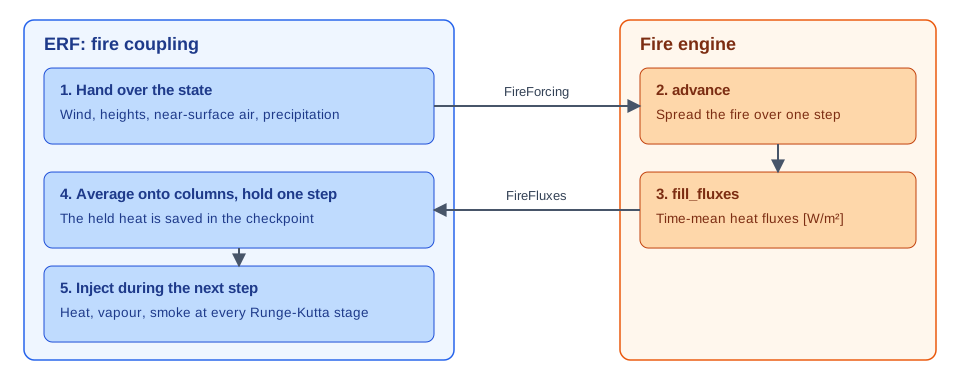
At start-up, the coupler builds the fire grid by refining one AMR level by
erf.fire.grid_ratioin x and y.Each step, it passes the engine the face velocities, the cell-centre heights, the air temperature and relative humidity of the lowest cell, and the surface precipitation if the engine requests it.
The engine advances and returns the sensible and latent heat fluxes into the air [W/m²], averaged over its step.
The coupler averages these fluxes onto the atmospheric columns and holds them for one step.
It injects them at every Runge-Kutta stage of the next step, together with the smoke tracer when smoke is enabled.
Steps 4 and 5 apply to lagged and synchronous coupling. With passive
coupling no heat is injected; only the smoke tracer is, when enabled.
The held fluxes are written to the checkpoint, so a restarted run injects the same heat in its first step as an uninterrupted run.
Limitations
The level that hosts the fire grid must keep the same boxes for the whole run.
Its boxes must form a single rectangle, and each box must span the full height of the level, so a refined fire level must extend to the domain top.
Every box length in x and y must be divisible by the grid ratio.
The bottom boundary must be a surface layer, unless the engine declares that it reads nothing from one.
When the fire grid lies below the finest level, average-down overwrites the heated cells beneath the finer level and that heat is lost; the coupler warns at start-up.
A restart that regenerates the level-0 grids stops before the checkpoint is read.
Coupling inputs
Input |
Effect |
|---|---|
|
Enables the fire |
|
Selects the compiled-in engine |
|
Fire cells per atmospheric cell in x and y |
|
Level refined by the fire grid; -1 selects the finest |
|
|
|
Multiplier on the injected fluxes; 0 gives one-way coupling |
|
|
|
E-folding depth of the exponential profile (default 45 m) |
|
Distributes the heat using the open fraction and roof height reported by the engine |
|
Divides the tendency by the Exner function (default true) |
|
Multiplies the tendency by the air density |
|
Injects the latent flux into the water vapour equation |
|
|
|
Injects the smoke tracer; requires |
|
Smoke mass per unit fuel mass burned (default 0.02 kg/kg) |
|
Controls the engine’s fire plotfile |
|
Prints per-step coupling diagnostics |
Each engine reads its own inputs under its own prefix; fire.<engine>.* is
recommended.
Implementing a fire engine
An engine derives from FireEngine (Source/FireCoupling/ERF_FireEngine.H) and
registers itself in a .cpp file compiled as source:
ERF_REGISTER_FIRE_ENGINE(MyEngine, "my_fire")
Required method |
Purpose |
|---|---|
|
Returns the engine’s name |
|
Checks the mesh and inputs at start-up |
|
Sets up the engine on the fire grid |
|
Advances the fire over one step |
|
Returns the sensible and latent fluxes, averaged over that step |
|
Heat released per kilogram of fuel burned |
Optional methods cover checkpoint and plotfile output, surface precipitation, the
surface-layer requirement, building open fraction and roof height, and fields
offered to other surface models. An engine that keeps the default
read_checkpoint stops a restarted run with an explanatory message.
An engine directory contains ERFFireEngine.cmake for CMake and Make.package
for GNU make. To start a new engine, copy Tests/FireEngineExample or the
template, then follow the sections “Adding a fire engine” and “The engine
contract” in the ERF documentation, which define the rules for fluxes, water and
GPU memory.