FLARE
FLARE (Fire-Line Advancement and Reaction Engine) is the fire engine in
erf-model/FLARE. It was the native fire
model on the ERF-Fire branch of hgopalan/ERF until October 2026.
The FLARE repository is a full copy of ERF plus the engine and other additions.
It takes ERF development merges regularly. The
FLARE README
describes its capabilities and how to build it. This page covers how FLARE maps to
ERF, and what its repository holds that is not the engine.
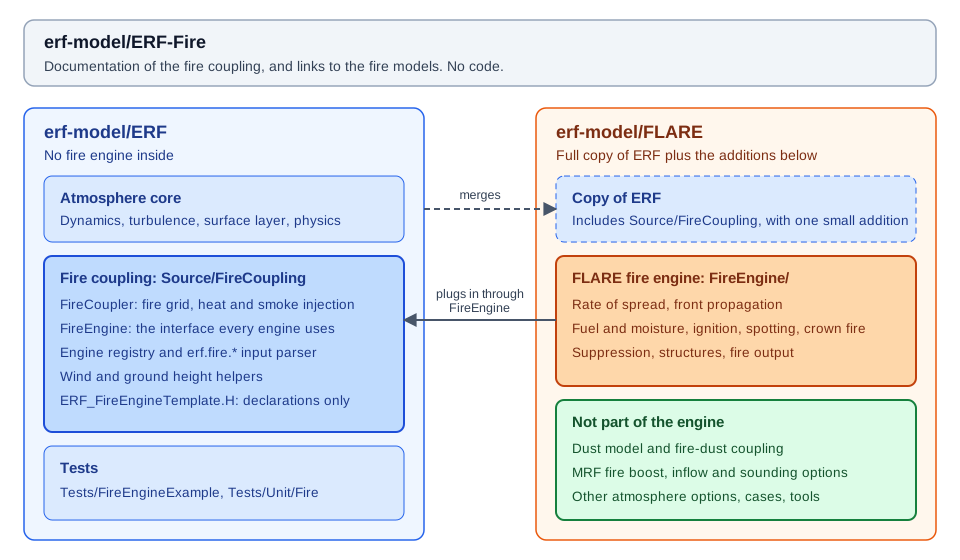
How FLARE maps to ERF
Coupling item |
In FLARE |
|---|---|
Engine directory |
|
Registration |
|
Selection |
|
Build |
|
Fire engine contents. The rate-of-spread models, the Huygens and level-set front propagation, fuel and fuel moisture, ignition, acceleration, spotting, crown fire, suppression, structure ignition, and the fire plotfile, statistics and checkpoint.
In the FLARE repository but not in the engine
These items are outside FireEngine/. Some are used by fire runs, but none is
part of the engine, and none is in ERF development yet.
Item |
Where in FLARE |
Inputs |
What it does |
Tied to fire? |
|---|---|---|---|---|
Dust model |
|
|
Emission, settling, deposition and health diagnostics for bare mineral surfaces |
No |
Fire-dust coupling |
|
|
Feeds the fire’s burned area, outflow wind and heat flux into dust emission |
Yes |
MRF fire boost |
|
|
Raises the convective velocity scale of the MRF scheme with the fire’s heat flux |
Yes |
Terrain-following inflow |
|
|
Looks up the inflow at each boundary cell’s height above its own ground |
No |
Sounding above ground |
|
|
Two separate switches that measure sounding winds, or theta, from each column’s ground; with theta, each column is then rebalanced hydrostatically |
No |
Geostrophic start |
|
|
ERF uses this key as forcing only. FLARE also starts the velocity from it, for uniform initialisation with no problem-specific velocity |
No |
Warm bubble |
|
|
Adds a theta bubble in the form of WRF’s idealized fire start |
No |
Building-roof stability |
|
|
Adds the Louis (1979) stability factors on roofs |
No |
Imposed surface heat flux |
|
|
ERF has this key for other flux types. FLARE also accepts it with |
No |
Joining fine boxes stacked in z |
|
None |
Joins refined boxes stacked in z when a level is made, and checks that column PBL schemes get full columns |
No |
Cases and tools |
|
Fire and dust cases; LANDFIRE fuel map, HRRR winds and map movie scripts |
Mostly |
The dust model is the largest of these. It uses the same surface-grid design as
the fire model, but it runs with ERF_ENABLE_DUST=ON and a fire is not required.
FLARE also has one small addition to the coupling code that ERF does not have: the
ERF_FIRE_DEFAULT_ENGINE compile definition, read in
Source/FireCoupling/ERF_FireCouplingParams.cpp and set in
CMake/BuildERFExe.cmake and Exec/Make.ERF. It lets a build name the engine a deck
gets when the deck names none.
This list compares FLARE 690bc4668 with its last common commit with ERF,
6e260ec28, and ERF development at 44c18fd4a, on 2026-10-30. Merges in either
direction will change it. To repeat the comparison:
git diff --name-status $(git merge-base upstream/development flare/development) flare/development -- Source
FLARE model documentation
The pages below describe the FLARE fire model and its inputs. They are copied
from the FLARE documentation
by tools/sync_flare_docs.py; edit them in FLARE and rerun the script.