WUI Validation Case
Exec/CanonicalTests/Fire/WUI_Subdivision is the case that exercises the
wildland-urban interface (WUI) features together, on a scenario built to be
checked: a wind-driven grass fire running from open wildland into three rows
of houses. There is no field dataset behind it. What it validates is each
piece of the coupled result against something independent: the head spread
rate against Rothermel’s model, the structures against the rule that they
never burn, the subdivision against the delay a row of obstacles must impose,
defensible space against the exposure it must remove, embers against the
count that must land, and the fuel against conservation.
The scenario
A 960 by 480 by 240 m domain at 10 m in the atmosphere and 5 m on the fire
grid, a neutral 10 m/s sounding entering at the west face and leaving at the
east face, periodic in y, a Smagorinsky closure and a MOST surface layer.
The fuel is Anderson model 1, short grass, at 6% moisture, ignited as a 40 m
disc at x = 340 m. Three rows of eight 20 m square, 8 m tall houses stand at
x = 520, 600 and 680 m. Each 60 m of y holds a house, a 20 m grass lane and a
20 m street; the streets run with the wind and block nothing, the lanes carry
the fire through the rows and the houses take a third of the width out of it.
The lanes and streets are 20 m because the immersed forcing blanks every
atmosphere cell that touches a house node, so a 10 m gap in the 10 m
atmosphere grid is a wall: with 10 m lanes the lowest-layer wind behind the
first row fell to a few centimetres per second and the coupled fire crawled
through the lanes at the no-wind rate. gen_wui.py draws
the heightmap (which the fire’s structure mask and the immersed forcing share)
and the two fuel maps.
Five variants share one base deck:
wildland: uniform grass, no houses, no spotting. The reference for the spread rate and the fuel budget.wildland_spotting: uniform grass with the seeded spotting of the subdivision variants. The reference for the delay through the subdivision, so that the houses are the only difference.subdivision: the houses as non-burnable structures with the level set extrapolated into them, the streets non-burnable through the fuel map, per-structure exposure diagnostics and seeded Albini spotting. The atmosphere is not fed back.defensible: the subdivision with a 30 m fuel break along the wildland edge and 10 m cleared around every house, which removes the lanes, so the front cannot reach a house by contact and only embers can.coupled: the subdivision with the houses standing in the atmosphere as immersed-forcing buildings, the fire’s wind read from the open columns beside them, lagged heat coupling with the additive source placed in the open part of each column.
The checks
check_wui.py reads the last fire plotfile of each variant, the exposure
CSVs and the logs, prints a table and fails on any of these:
Spread rate. The head rate of spread along the centreline between x = 400 and 470 m of the
wildlandrun, from the arrival-time field, must lie between the Wulff tip of the projection formula and 1.15 times the model’s own rate at the wind the fire samples: the run mean, over the arrival window, of the largest rate the fire reports each step (the surface layer slows the sounding’s 10 m/s at 6.1 m as the run proceeds). Rothermel (1972) is written out in the check, independent of the code: at the sounding wind, the Andrews wind adjustment factor and the Rothermel wind limit of 0.9 I_R it gives 1.385 m/s, the run’s rate at t = 0; the window mean is 0.830 m/s and the head 0.599 m/s, 72 % of it, the degradation of a curved front’s head under the default directional coupling (see FireAdvectiveWindCoupling). Until 2026-10 the 300 ft/min fuel-class cap held every wind above 1.52 m/s at 0.2501 m/s, which the check then matched to 15 %;erf.fire.wind_limit = fuel_classrestores that cap.Fuel conservation. The fuel consumed over the burned area of the
wildlandrun equals the initial load over the burned area within 5%; cells the front reached in the last minute are still burning.Structures never burn. No fire cell inside a footprint has a negative level set and none has lost fuel, in all three subdivision variants.
The subdivision delays the front. The
subdivisionfire reaches x = 780 m, beyond the last row, later than thewildland_spottingfire does, and at least one house is reached by the front.Embers land. At least one brand lands on a footprint in the
subdivisionrun (the seed is fixed, so the count is reproducible).Defensible space works. In the
defensiblerun fewer houses are reached by the front and the maximum heat load at a house is lower than in thesubdivisionrun.The coupled run stands up. No NaN in the log, a plume (maximum vertical velocity above 0.5 m/s in the last atmosphere plotfile), and the fire reaches x = 780 m.
Houses ignite and spread. The
ignitionvariant runs the subdivision with Structure Ignition and House-to-House Spread on, with the ignition thresholds at a third of the documented defaults (at the defaults no house ignites in this case; the README has both runs). At least one house ignites, a later one after the first, and at least one ignited house had not been reached by the front when it ignited, which is house-to-house spread by radiation or brands; the plotfile state of every ignited house agrees with the CSV; no footprint cell burns or loses fuel. On 2026-09-16, with the thresholds at a third of the defaults, 19 of the 24 houses ignited between 250 and 1880 s, all by heat load; nine before the front reached their wall band and two whose band the front never reached, from their neighbours’ radiation alone. At the documented defaults no house ignites in 2100 s: the grass fire leaves at most 3.1 MJ/m² at a wall, peaks at 773 kW/m and drops at most 15 brands on a footprint.
The exposure numbers are also reported against the threshold usually quoted for the ignition of wood by radiation, about 20 kW/m² (Cohen 2004), as a reading rather than a check: the model’s fireline intensity per metre of front is not a flux on a wall, and the wall energy balance that would turn it into one is future work.
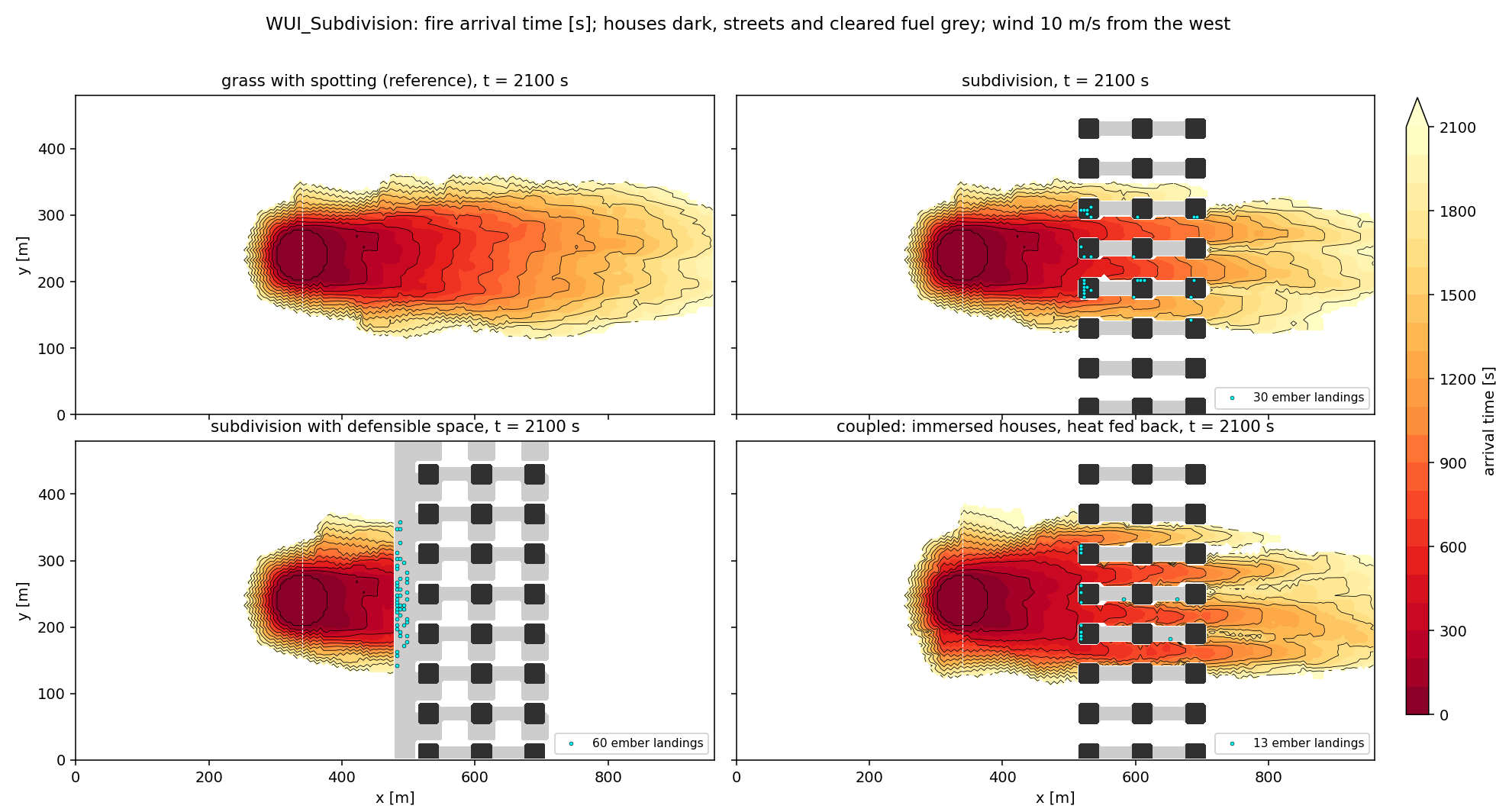
Fig. 1 Fire arrival time at 2100 s in four of the variants: grass with spotting, the subdivision, the subdivision with defensible space, and the coupled run with immersed houses and the heat fed back. Houses are dark, streets and cleared fuel grey, ember landings cyan; the wind is 10 m/s from the west.
What building it found
The fire grid inherits the atmosphere’s periodicity, and with the inflow and
outflow in x of this case nothing filled the level set’s ghost cells beyond
the west and east faces, so the gradient stencil read uninitialised memory
there. With one box per rank the run happened to survive; with two boxes on
a rank the level set blew up at the inflow face on the third step. Every
fire-grid exchange now extrapolates the nearest interior value into the ghost
cells of a non-periodic face (fire_fill_boundary in ERF_FireGrid.H),
and five box layouts on one to four ranks give the same fire to roundoff.
Periodic cases are unchanged. The perimeter in the statistics CSV was counted
inside each box only, so it depended on the decomposition; it now reads a
ghost-filled copy of the arrival time and stops at the domain.
The level set also ran ahead of its own rate of spread: with fire_ros at
0.250 m/s everywhere the head moved at 0.250 m/s for the first hundred
metres and then at 0.29-0.45 m/s. The gradient norm took whichever one-sided
difference was larger in magnitude regardless of sign, which is not the
Godunov scheme; wherever the level set is convex ahead of the front the
downwind slope won and the update was anti-dissipative. Removing the
artificial viscosity brought the overshoot forward and a wider or more
frequent reinitialisation did nothing. The norm now uses the Osher-Sethian
choice for an expanding front (Front Propagation), and the head
speed is 0.250 m/s on every 40 m segment. The scheme had been described as a
fifth-order WENO-Z reconstruction; that reconstruction was never called, and
the descriptions now say what the code does.
Running it
cd Exec/CanonicalTests/Fire/WUI_Subdivision
MPIRUN="mpirun -np 2" ./run_wui.sh /path/to/erf_exec
The domain is two boxes, so at most two ranks. Each variant runs 2100 s, the
passive ones in about half an hour and the coupled one in about an hour. SKIP_RUN=1 re-runs only the checks. The reference results are
in the README of the case.
References
Rothermel, R. C. (1972). A mathematical model for predicting fire spread in wildland fuels. USDA Forest Service Research Paper INT-115.
Andrews, P. L. (2012). Modeling wind adjustment factor and midflame wind speed for Rothermel’s surface fire spread model. USDA Forest Service General Technical Report RMRS-GTR-266.
Albini, F. A. (1983). Potential spotting distance from wind-driven surface fires. USDA Forest Service Research Paper INT-309.
Cohen, J. D. (2004). Relating flame radiation to home ignition using modeling and experimental crown fires. Canadian Journal of Forest Research, 34, 1616-1626.
NFPA 1144 (2018). Standard for Reducing Structure Ignition Hazards from Wildland Fire. National Fire Protection Association.