Ground of the atmospheric columns, seen from the fire grid. More...
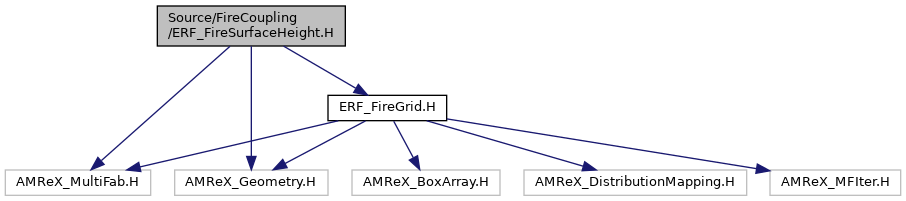
Go to the source code of this file.
Functions | |
| void | compute_fire_surface_height (amrex::MultiFab &fire_surface_z, const amrex::MultiFab *z_phys_nd, const amrex::Geometry &geom_atm, const FireGrid &fg) |
| Fill the ground elevation of each fire cell's atmospheric column. More... | |
| void | compute_fire_column_grounds (amrex::MultiFab &fire_col_ground, const amrex::MultiFab *z_phys_nd, const amrex::Geometry &geom_atm, const FireGrid &fg) |
| Fill the ground elevations of a fire cell's bilinear wind stencil. More... | |
Detailed Description
Ground of the atmospheric columns, seen from the fire grid.
The atmosphere side of the fire coupling: the ground elevation the shared wind sampler (ERF_FireWindExtract.H) measures its sampling height from, for the column holding each fire cell and for the four columns of its bilinear stencil. Terrain slopes, which a fire engine may take from its own fire-resolved terrain, are the engine's.
Function Documentation
◆ compute_fire_column_grounds()
| void compute_fire_column_grounds | ( | amrex::MultiFab & | fire_col_ground, |
| const amrex::MultiFab * | z_phys_nd, | ||
| const amrex::Geometry & | geom_atm, | ||
| const FireGrid & | fg | ||
| ) |
Fill the ground elevations of a fire cell's bilinear wind stencil.
Bilinear wind interpolation blends the four atmospheric columns surrounding a fire cell. Each of those columns has its own ground, and near the surface the wind profile is anchored to it, so every column has to be sampled at the same height above its own ground before the horizontal blend. Over the ridge of the ROS_Slope_Effects case, neighbouring column grounds differ by up to 28 m, so blending at a single absolute height would sample a neighbour at 35 m above ground while asking for 6 m.
Component c holds the ground of stencil column c, ordered (i0,j0), (i0+1,j0), (i0,j0+1), (i0+1,j0+1), with i0 = floor((i_f + 0.5)/C - 0.5).
- Parameters
-
[out] fire_col_ground 4-component MultiFab on the fire grid [m] [in] z_phys_nd Nodal terrain height from ERF [m], or nullptr for flat terrain, in which case the domain floor is used [in] geom_atm Geometry of the level the fire grid refines [in] fg Fire grid structure
Called once by the fire engine at initialisation; terrain is static.
◆ compute_fire_surface_height()
| void compute_fire_surface_height | ( | amrex::MultiFab & | fire_surface_z, |
| const amrex::MultiFab * | z_phys_nd, | ||
| const amrex::Geometry & | geom_atm, | ||
| const FireGrid & | fg | ||
| ) |
Fill the ground elevation of each fire cell's atmospheric column.
The fire module extracts wind at a height above ground by walking the atmospheric column's z_phys_cc profile, so the ground it measures from has to be the ground of that same column: the average of the four k = 0 nodes of atmospheric cell (i_f/C, j_f/C). Taking the first cell centre instead puts the extraction height half an atmospheric cell too high, and by an amount that changes with vertical resolution.
This is deliberately the atmospheric column's ground, not the fire-resolved terrain, even when a finer terrain file is supplied for the slopes: the wind profile being interpolated belongs to the atmospheric column.
- Parameters
-
[out] fire_surface_z 1-component MultiFab on the fire grid [m] [in] z_phys_nd Nodal terrain height from ERF [m], or nullptr for flat terrain, in which case the domain floor is used [in] geom_atm Geometry of the level the fire grid refines [in] fg Fire grid structure
Called once by the fire engine at initialisation; terrain is static.
