|
| void | define (const amrex::BoxArray &ba, const amrex::Box &domain) |
| | Build from a level's grids; call from the scheme's Init (which also runs on regrid) More...
|
| |
| bool | needs_gather () const |
| | True when some column is split between boxes, so the fields must be gathered. More...
|
| |
| bool | boxes_span_domain () const |
| | True when every box spans the domain in z (required by the Fortran bridges) More...
|
| |
| template<std::size_t N> |
| void | gather (std::array< FabPtr, N > &vars, std::array< FabPtr, N > &saved) const |
| | Swap each non-null field for a copy on the column layout; the originals go to saved. More...
|
| |
| template<std::size_t N> |
| void | scatter (std::array< FabPtr, N > &vars, std::array< FabPtr, N > &saved) const |
| | Copy the column-layout fields back into the originals and restore them. More...
|
| |
| FabPtr | gather_one (const amrex::MultiFab &src) const |
| | Copy of a field (cell-centered or z-face; with its ghost cells) on the column layout. More...
|
| |
| std::unique_ptr< amrex::MultiFab > | gather_nodal (const amrex::MultiFab *src) const |
| | Copy of a nodal field (e.g. z_phys_nd) on the column layout, or null for null input. More...
|
| |
| std::unique_ptr< amrex::iMultiFab > | gather_2d (const amrex::iMultiFab *src) const |
| | Copy of a 2D (z-flattened) integer field (e.g. lmask) on the column layout, or null. More...
|
| |
Morrison, WSM6 and WDM6 sediment each column inside one per-column kernel over the k range of the box they are handed: the box top is treated as the top of the column (no inflow) and the box bottom as its ground (outflow booked as surface precipitation). That is only right when no column is split between boxes.
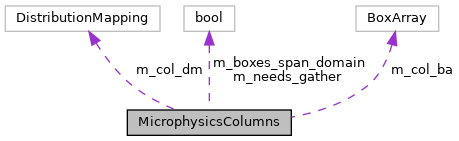
This class records, for one level's grids, whether any column is split between boxes stacked in z, and if so builds a "column layout": a BoxArray covering exactly the same cells in which every contiguous vertical run of covered cells lies inside one box. A scheme then copies its fields onto that layout, runs its unchanged column kernels, and copies the result back. The kernels only read and write their own column, so this gives the same arithmetic as a run whose grids were never split in z.
A run that does not reach the domain bottom (e.g. a refined patch aloft) has no ground, so the schemes accumulate surface precipitation only where klo is the domain bottom.