#include <ERF_NodalReconstruction.H>
Public Types | |
| using | Real = amrex::Real |
Public Member Functions | |
| NodalReconstruction (amrex::Box const &w_face_slice_box, amrex::Geometry const &geom) | |
| Construct a nodal reconstruction object for one horizontal slice. More... | |
| amrex::Box const & | nodalBox () const noexcept |
| amrex::FArrayBox | makeReference (amrex::FArrayBox const &T) const |
| std::pair< amrex::FArrayBox, SolveInfo > | solve (amrex::FArrayBox const &T, amrex::FArrayBox const &reference, VariationOperator var_op, Real relative_tolerance=Real(1.e-10), Real smoothing=Real(1.e-2), Real min_regularization=Real(2.5e-4), int max_iterations=1000) |
| Real | maxAverageError (amrex::FArrayBox const &T, amrex::FArrayBox const &S) const |
| max_ij | avg4(S) - T | More... | |
| Real | totalSquaredVariation (amrex::FArrayBox const &S) const |
Private Member Functions | |
| void | applyA (amrex::FArrayBox const &S, amrex::FArrayBox &T) const |
| (A S)(i,j) = 1/4 [ S(i,j) + S(i+1,j) + S(i,j+1) + S(i+1,j+1) ] More... | |
| void | applyAT (amrex::FArrayBox const &T, amrex::FArrayBox &R) const |
| Adjoint of applyA: scatter each w-face value to its four nodes. More... | |
| void | applyD (amrex::FArrayBox const &S, amrex::FArrayBox &difx, amrex::FArrayBox &dify) const |
| Compute the first derivatives of the nodal field. More... | |
| void | applyDT (amrex::FArrayBox const &difx, amrex::FArrayBox const &dify, amrex::FArrayBox &R) const |
| Apply the adjoint of the derivative operator. More... | |
| void | applyDTD (amrex::FArrayBox const &S, amrex::FArrayBox &R) const |
| Apply the product of the derivative operator and its adjoint. More... | |
| void | applyL (amrex::FArrayBox const &S, amrex::FArrayBox &lap) const |
| Apply the Laplacian operator to a nodal field. More... | |
| void | applyLT (amrex::FArrayBox const &lap, amrex::FArrayBox &R) const |
| Apply the adjoint of the Laplacian operator. More... | |
| void | applyLTL (amrex::FArrayBox const &S, amrex::FArrayBox &R) const |
| Apply the product of the Laplacian operator and its adjoint. More... | |
| void | applyVariationOperator (amrex::FArrayBox const &S, amrex::FArrayBox &R) const |
| Apply the selected variation operator (first derivative or Laplacian). More... | |
| void | applyM (amrex::FArrayBox const &S, amrex::FArrayBox &R) const |
| R = ( A^T A + lambda V^T V + mu I ) S. More... | |
| void | computeDiagonal (amrex::FArrayBox &diag) const |
| void | computeDiagnostics (amrex::FArrayBox const &T, amrex::FArrayBox const &S, SolveInfo &info) const |
| Compute diagnostic metrics for the reconstructed nodal field. More... | |
| Real | maxAbs (amrex::FArrayBox const &F) const |
| SolveInfo | conjugateGradient (amrex::FArrayBox const &rhs, amrex::FArrayBox &x, Real relative_tolerance, int max_iterations) const |
| void | applyJacobi (amrex::FArrayBox const &diag, amrex::FArrayBox const &r, amrex::FArrayBox &z) const |
| Apply the Jacobi preconditioner. More... | |
| Real | dot (amrex::FArrayBox const &a, amrex::FArrayBox const &b) const |
Private Attributes | |
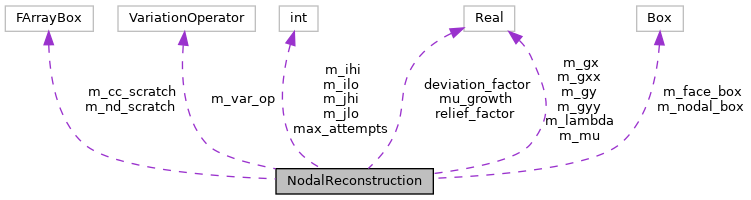
| amrex::Box | m_w_face_slice_box |
| amrex::Box | m_nodal_box |
| amrex::Box | m_x_edge_box |
| amrex::Box | m_y_edge_box |
| amrex::Box | m_interior_nodal_box |
| int | m_ilo =0 |
| int | m_ihi =-1 |
| int | m_jlo =0 |
| int | m_jhi =-1 |
| amrex::Real | m_gx = one |
| amrex::Real | m_gy = one |
| amrex::Real | m_gxx = one |
| amrex::Real | m_gyy = one |
| amrex::Real | m_lambda = zero |
| amrex::Real | m_mu = zero |
| VariationOperator | m_var_op = VariationOperator::FirstDeriv |
| amrex::FArrayBox | m_w_face_scratch |
| amrex::FArrayBox | m_nd_scratch |
| amrex::FArrayBox | m_difx |
| amrex::FArrayBox | m_dify |
| amrex::FArrayBox | m_lap |
Static Private Attributes | |
| static constexpr amrex::Real | deviation_factor = amrex::Real(2.0) |
| static constexpr amrex::Real | relief_factor = amrex::Real(0.25) |
| ... nor than this fraction of the relief of the data. More... | |
| static constexpr amrex::Real | mu_growth = amrex::Real(4.0) |
| static constexpr int | max_attempts = 24 |
Detailed Description
Reconstruct a nodal field S from data T that lives at w-faces, such that the four-node average of S matches T as closely as a bounded, smooth nodal field can.
Why we do not simply invert the averaging operator
The four-node averaging operator A,
(A S)(i,j) = 1/4 [ S(i,j) + S(i+1,j) + S(i,j+1) + S(i+1,j+1) ] ,
has symbol cos(kx/2) cos(ky/2), which vanishes at the grid Nyquist mode. Inverting A exactly – e.g. with the back substitution
S(i+1,j+1) = 4 T(i,j) - S(i,j) - S(i+1,j) - S(i,j+1)
– therefore amplifies grid-scale content of T without bound. The Green's function of that recursion is 4 / [(1+x)(1+y)], a doubly alternating cumulative sum, so a checkerboard component of T of amplitude a produces a nodal response of amplitude a*i*j. On a 128^2 grid an O(10 m) grid-scale roughness in the WRF terrain thus yields nodal heights that are kilometers away from the WRF terrain, including physically impossible negative elevations (ERF issue #3709). Adding a free homogeneous solution cannot repair this: the null space of A is spanned by (-1)^i f(j) + (-1)^j g(i), which cannot represent the (-1)^(i+j) i j growth of the particular solution. The failure is silent, because checking that avg4(S) reproduces T is then satisfied by construction.
What we do instead
Let S_ref be the direct interpolation of T to the nodes (makeReference) and R = T - A S_ref the part of T that interpolation fails to reproduce. We solve for a correction E to the interpolant,
min_E || A E - R ||^2 + lambda || V E ||^2 + mu || E ||^2 , S = S_ref + E,
where V is a roughness operator (first derivative or Laplacian). The normal equations
( A^T A + lambda V^T V + mu I ) E = A^T R
are symmetric positive definite for any mu > 0, so E exists, is unique, and – unlike the exact inverse – is bounded. Specifically, writing ( A^T A + lambda V^T V + mu I ) E = A^T R and pairing with E gives
|| A E ||^2 + lambda || V E ||^2 + mu || E ||^2 <= || A E || || R || ,
and since 2 sqrt(mu) ||A E|| ||E|| <= ||A E||^2 + mu ||E||^2, we get the a priori bound
|| E || <= || R || / ( 2 sqrt(mu) ) .
The correction is therefore controlled by how badly interpolation already fails, never by the conditioning of A.
Choosing mu
A single fixed mu cannot serve both smooth and rough terrain: small mu recovers well-resolved features almost exactly but lets rough fields drift far from the interpolant, and large mu does the reverse. We therefore start from a small mu and raise it until the correction satisfies the pointwise cap
max |E| <= min( 2 max|R| , 1/4 (max T - min T) ) ,
i.e. the nodes may not move away from the direct interpolation by more than twice the interpolation misfit, nor by more than a quarter of the relief of the data. Because ||E|| -> 0 as mu -> infinity the loop always terminates, and on failure we fall back to the interpolant itself. Smooth terrain keeps the smallest mu and is reproduced to well below the interpolation error; rough terrain is pulled back toward the interpolant instead of blowing up.
The averaging error max |avg4(S) - T| returned in SolveInfo is now a genuine diagnostic – it is no longer satisfied by construction – and is reported alongside the same quantity for the plain interpolant and the range of S, so callers can sanity check the result.
Member Typedef Documentation
◆ Real
| using NodalReconstruction::Real = amrex::Real |
Constructor & Destructor Documentation
◆ NodalReconstruction()
|
inlineexplicit |
Construct a nodal reconstruction object for one horizontal slice.
The operator that is inverted is the purely horizontal four-node average, so the only thing that matters about the input is that it carries the w-face staggering; whether the heights come from the wrfinput geopotential at a z-face or from the metgrid surface field HGT_M is irrelevant here.
- Parameters
-
w_face_slice_box Box specifying the data region: w-face staggered, a single slab at k = 0. geom Geometry used for grid spacing and anisotropy weights.
Member Function Documentation
◆ applyA()
|
inlineprivate |

◆ applyAT()
|
inlineprivate |

◆ applyD()
|
inlineprivate |
Compute the first derivatives of the nodal field.
- Parameters
-
[in] S Nodal field. [out] difx Resulting x-derivatives. [out] dify Resulting y-derivatives.
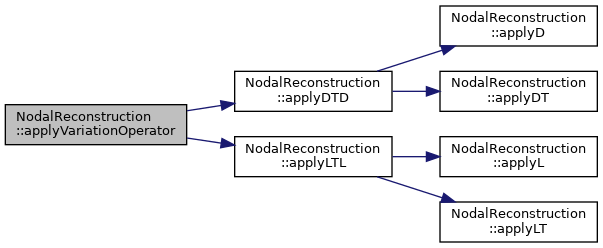
Referenced by applyDTD().

◆ applyDT()
|
inlineprivate |
Apply the adjoint of the derivative operator.
- Parameters
-
[in] difx X-derivatives. [in] dify Y-derivatives. [out] R Resulting nodal field.
Referenced by applyDTD().

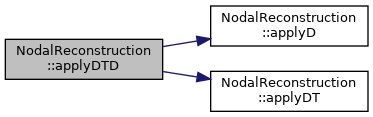
◆ applyDTD()
|
inlineprivate |
Apply the product of the derivative operator and its adjoint.
- Parameters
-
[in] S Nodal field. [out] R Resulting nodal field.
Referenced by applyVariationOperator().

◆ applyJacobi()
|
inlineprivate |
Apply the Jacobi preconditioner.
- Parameters
-
[in] diag Operator diagonal. [in] r Residual field. [out] z Preconditioned residual field.
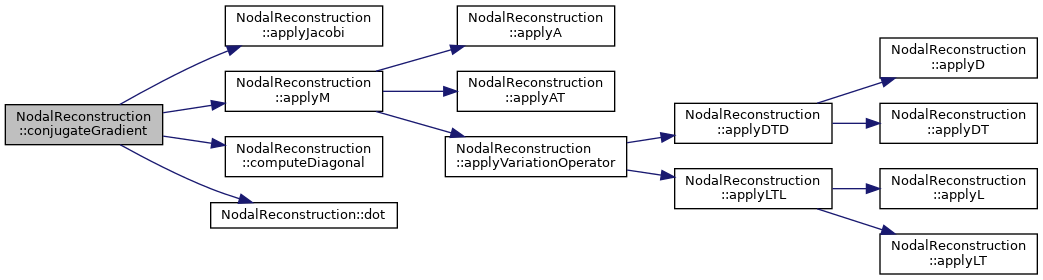
Referenced by conjugateGradient().

◆ applyL()
|
inlineprivate |
Apply the Laplacian operator to a nodal field.
- Parameters
-
[in] S Nodal field. [out] lap Resulting Laplacian field.
Referenced by applyLTL().

◆ applyLT()
|
inlineprivate |
Apply the adjoint of the Laplacian operator.
- Parameters
-
[in] lap Laplacian field. [out] R Resulting nodal field.
Referenced by applyLTL().

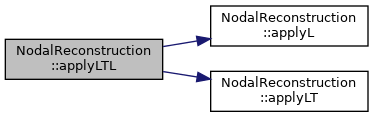
◆ applyLTL()
|
inlineprivate |
Apply the product of the Laplacian operator and its adjoint.
- Parameters
-
[in] S Nodal field. [out] R Resulting nodal field.
Referenced by applyVariationOperator().

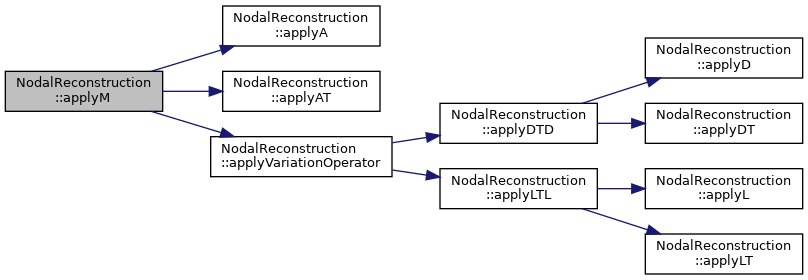
◆ applyM()
|
inlineprivate |
R = ( A^T A + lambda V^T V + mu I ) S.
Apply the full system operator M = A^T A + lambda V^T V + mu I.
- Parameters
-
[in] S Nodal field. [out] R Resulting nodal field.
Referenced by conjugateGradient().

◆ applyVariationOperator()
|
inlineprivate |
Apply the selected variation operator (first derivative or Laplacian).
- Parameters
-
[in] S Nodal field. [out] R Resulting nodal field.
Referenced by applyM().

◆ computeDiagnostics()
|
inlineprivate |
Compute diagnostic metrics for the reconstructed nodal field.
- Parameters
-
[in] T W-face data. [in] S Reconstructed nodal field. [in,out] info Structure to store diagnostics.
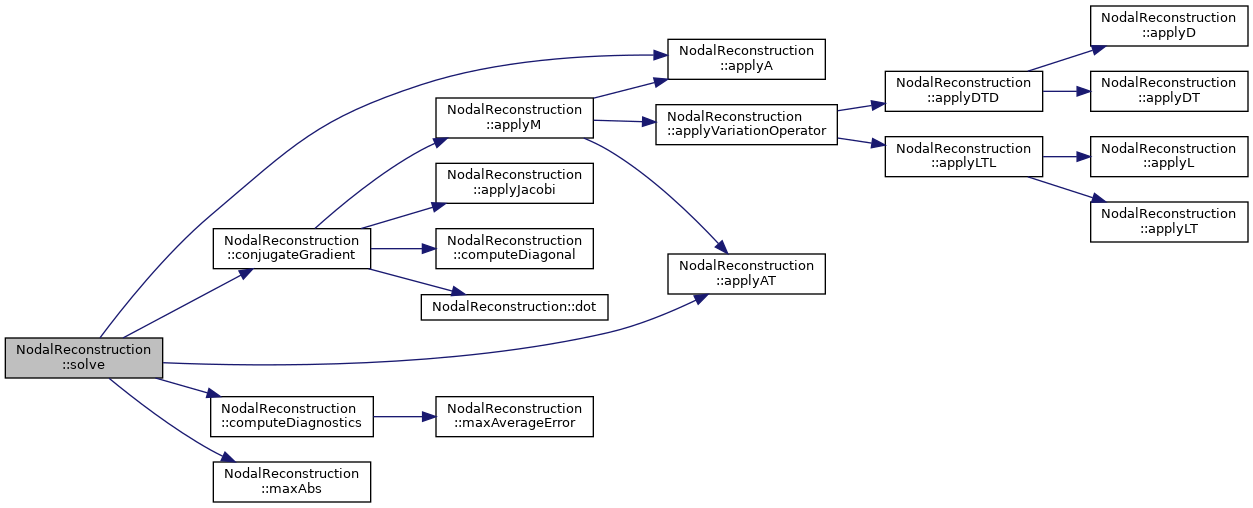
Referenced by solve().


◆ computeDiagonal()
|
inlineprivate |
Diagonal of M, assembled by accumulating the square of every stencil coefficient that touches a node. Used as a Jacobi preconditioner.
Referenced by conjugateGradient().

◆ conjugateGradient()
|
inlineprivate |
Jacobi-preconditioned conjugate gradient on the SPD operator M. x is both the initial guess and the result; it is reset to zero here because every attempt restarts the correction from the interpolant.
Local storage for the operator diagonal.
Local storage for the residual.
Local storage for the preconditioned residual.
Local storage for the search direction.
Local storage for the product of the operator and the search direction.
Referenced by solve().

◆ dot()
|
inlineprivate |

◆ makeReference()
|
inline |
Direct interpolation of the w-face data to the nodes: the average of the (up to four) w-faces that touch each node, with edge and corner nodes taking the average of the w-faces that exist. This is the field the solve corrects, and the field it falls back to.
Local storage for the reference nodal field.
Referenced by reconstruct_nodal_height_slice().

◆ maxAbs()
|
inlineprivate |

◆ maxAverageError()
|
inline |
max_ij | avg4(S) - T |
Referenced by computeDiagnostics().

◆ nodalBox()
|
inlinenoexcept |
◆ solve()
|
inline |
Solve the regularized least-squares problem described above.
- Parameters
-
T w-face data to be matched reference the interpolant to correct (see makeReference) var_op roughness operator used as the smoothness prior relative_tolerance CG stopping tolerance smoothing lambda; weight of the roughness penalty min_regularization smallest mu tried; raised by factors of four until the correction respects its cap max_iterations CG iteration cap per attempt
Local storage for the interpolation misfit.
Local storage for the right-hand side of the normal equations.
Local storage for the nodal correction.
Local storage for the reconstructed nodal field.
Referenced by reconstruct_nodal_height_slice().

◆ totalSquaredVariation()
|
inline |
Member Data Documentation
◆ deviation_factor
|
staticconstexprprivate |
The correction may not move a node further from the direct interpolation than this multiple of the interpolation misfit ...
Referenced by solve().
◆ m_difx
|
mutableprivate |
Scratch for the roughness operators, which are applied once per CG iteration; sized in solve() so the iteration itself never allocates.
Referenced by applyDTD(), and solve().
◆ m_dify
|
mutableprivate |
Referenced by applyDTD(), and solve().
◆ m_gx
|
private |
Referenced by applyD(), applyDT(), computeDiagonal(), and NodalReconstruction().
◆ m_gxx
|
private |
Referenced by applyL(), applyLT(), computeDiagonal(), and NodalReconstruction().
◆ m_gy
|
private |
Referenced by applyD(), applyDT(), computeDiagonal(), and NodalReconstruction().
◆ m_gyy
|
private |
Referenced by applyL(), applyLT(), computeDiagonal(), and NodalReconstruction().
◆ m_ihi
|
private |
Referenced by applyA(), applyAT(), applyD(), applyDT(), applyJacobi(), applyL(), applyLT(), applyM(), computeDiagnostics(), computeDiagonal(), conjugateGradient(), dot(), makeReference(), maxAbs(), maxAverageError(), solve(), and totalSquaredVariation().
◆ m_ilo
|
private |
Referenced by applyA(), applyAT(), applyD(), applyDT(), applyJacobi(), applyL(), applyLT(), applyM(), computeDiagnostics(), computeDiagonal(), conjugateGradient(), dot(), makeReference(), maxAbs(), maxAverageError(), solve(), and totalSquaredVariation().
◆ m_interior_nodal_box
|
private |
Referenced by applyLTL(), NodalReconstruction(), and solve().
◆ m_jhi
|
private |
Referenced by applyA(), applyAT(), applyD(), applyDT(), applyJacobi(), applyL(), applyLT(), applyM(), computeDiagnostics(), computeDiagonal(), conjugateGradient(), dot(), makeReference(), maxAbs(), maxAverageError(), solve(), and totalSquaredVariation().
◆ m_jlo
|
private |
Referenced by applyA(), applyAT(), applyD(), applyDT(), applyJacobi(), applyL(), applyLT(), applyM(), computeDiagnostics(), computeDiagonal(), conjugateGradient(), dot(), makeReference(), maxAbs(), maxAverageError(), solve(), and totalSquaredVariation().
◆ m_lambda
|
private |
Referenced by applyM(), computeDiagonal(), and solve().
◆ m_lap
|
mutableprivate |
Referenced by applyLTL(), and solve().
◆ m_mu
|
private |
Referenced by applyM(), computeDiagonal(), and solve().
◆ m_nd_scratch
|
mutableprivate |
◆ m_nodal_box
|
private |
Referenced by conjugateGradient(), makeReference(), nodalBox(), NodalReconstruction(), and solve().
◆ m_var_op
|
private |
Referenced by applyVariationOperator(), computeDiagonal(), and solve().
◆ m_w_face_scratch
|
mutableprivate |
◆ m_w_face_slice_box
|
private |
Referenced by solve().
◆ m_x_edge_box
|
private |
Referenced by NodalReconstruction(), and solve().
◆ m_y_edge_box
|
private |
Referenced by NodalReconstruction(), and solve().
◆ max_attempts
|
staticconstexprprivate |
Referenced by solve().
◆ mu_growth
|
staticconstexprprivate |
Factor by which mu is raised when the cap is violated, and the number of times we are willing to do so.
Referenced by solve().
◆ relief_factor
|
staticconstexprprivate |
... nor than this fraction of the relief of the data.
Referenced by solve().
The documentation for this class was generated from the following file:
- Source/Utils/ERF_NodalReconstruction.H