Longwave (thermal) radiation using gray-gas two-stream model. More...
#include <AMReX_GpuControl.H>#include <AMReX_Math.H>#include <AMReX_FArrayBox.H>#include <AMReX_REAL.H>#include <cmath>
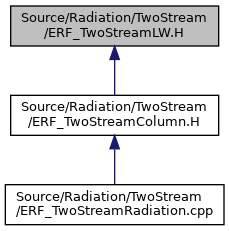
Go to the source code of this file.
Functions | |
| AMREX_GPU_HOST_DEVICE AMREX_FORCE_INLINE amrex::Real | compute_thermal_intensity (amrex::Real T, amrex::Real sigma) |
| Compute thermal (LW) intensity for a given temperature. More... | |
| AMREX_GPU_HOST_DEVICE AMREX_FORCE_INLINE amrex::Real | compute_lw_transmit (amrex::Real tau_lw) |
| Compute transmission coefficient through an absorbing layer. More... | |
| AMREX_GPU_HOST_DEVICE AMREX_FORCE_INLINE amrex::Real | compute_lw_flux_up (amrex::Real F_up_below, amrex::Real T_layer, amrex::Real sigma, amrex::Real tau_lw) |
| Compute upwelling LW flux in one layer of a two-stream sweep. More... | |
| AMREX_GPU_HOST_DEVICE AMREX_FORCE_INLINE amrex::Real | compute_lw_flux_down (amrex::Real F_down_above, amrex::Real T_layer, amrex::Real sigma, amrex::Real tau_lw) |
| Compute downwelling LW flux in one layer of a two-stream sweep. More... | |
| AMREX_GPU_HOST_DEVICE AMREX_FORCE_INLINE amrex::Real | compute_lw_heating_rate (amrex::Real F_net_top, amrex::Real F_net_bot, amrex::Real dz, amrex::Real rho, amrex::Real cp) |
| Compute LW heating rate from net flux divergence. More... | |
Variables | |
| constexpr amrex::Real | stefan_boltzmann = amrex::Real(5.670374419e-8) |
| Stefan-Boltzmann constant [W/(m^2 K^4)] used by the two-stream LW model. More... | |
Detailed Description
Longwave (thermal) radiation using gray-gas two-stream model.
Implements a simplified, clear-sky longwave radiation model using the gray-gas two-stream approximation (Toon et al. 1989):
Vertical orientation follows ERF: the vertical index k increases upward, so layer k = kmin touches the surface and k = kmax the top of the domain. Fluxes live on layer interfaces m = k - kmin (bottom of layer k) and m + 1 (top of layer k); m = 0 is the surface, m = nlev the TOA.
UPWARD SWEEP (from surface to TOA):
F_up(m+1) = F_up(m) * exp(-tau_lw) + sigma * T(k)^4 * (1 - exp(-tau_lw))
Initial condition: F_up(0) = emissivity * sigma * T_surface^4
- (1 - emissivity) * F_down(0) (gray surface: emitted plus reflected downwelling flux, so the downward sweep must be completed before the upward sweep starts)
DOWNWARD SWEEP (from TOA to surface):
F_down(m) = F_down(m+1) * exp(-tau_lw) + sigma * T(k)^4 * (1 - exp(-tau_lw))
Initial condition: F_down(nlev) = 0 (no incoming from space)
NET FLUX AND HEATING:
F_net(m) = F_up(m) - F_down(m) (positive upward) Q_lw(k) = -(1 / (rho * cp)) * [F_net(m+1) - F_net(m)] / dz(k) [K/s]
A layer that emits more than it absorbs has F_net increasing with height, so Q_lw < 0 (radiative cooling).
Layer temperature T(k) is the absolute temperature obtained from rho*theta through the Exner function (see get_temperature_from_rhotheta() in ERF_TwoStreamRadiation.cpp), not the potential temperature.
MODEL SIMPLIFICATIONS:
- Uniform optical depth (tau_lw) per layer
- No scattering
- No clouds
References:
- Toon, O. B., C. P. McKay, T. P. Ackerman, and K. Santhanam, 1989: Rapid calculation of radiative heating rates and photodissociation rates in inhomogeneous multiple scattering atmospheres. J. Geophys. Res., 94, 16387-16405. https://doi.org/10.1029/JD094iD13p16387
- Kirchhoff, G., 1860: Ueber den Zusammenhang zwischen den Emissionsvermögen und den Absorptionsvermögen der Körper für Wärmestrahlung. Monatsberichte der Akademie der Wissenschaften zu Berlin, 783-787.
Function Documentation
◆ compute_lw_flux_down()
| AMREX_GPU_HOST_DEVICE AMREX_FORCE_INLINE amrex::Real compute_lw_flux_down | ( | amrex::Real | F_down_above, |
| amrex::Real | T_layer, | ||
| amrex::Real | sigma, | ||
| amrex::Real | tau_lw | ||
| ) |
Compute downwelling LW flux in one layer of a two-stream sweep.
Implements the downward flux formula in the gray-gas two-stream model:
F_down_current = F_down_above * exp(-tau_lw) + sigma * T^4 * (1 - exp(-tau_lw))
This is called iteratively from the TOA (where F_down_toa = 0) downward to the surface.
- Parameters
-
[in] F_down_above Downwelling flux from the layer above [W/m^2]. [in] T_layer Temperature of the current layer [K]. [in] sigma Stefan-Boltzmann constant [W/(m^2·K^4)]. [in] tau_lw Optical depth of the current layer [unitless].
- Returns
- Downwelling flux at the bottom of the current layer [W/m^2].
- Note
- This function assumes each layer acts as a semi-infinite slab with uniform temperature and optical depth.
- Called within a device-side kernel; must be GPU-safe.
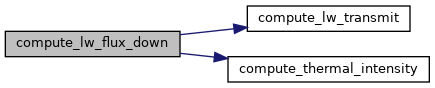
Referenced by vertical_two_stream_sweep().

◆ compute_lw_flux_up()
| AMREX_GPU_HOST_DEVICE AMREX_FORCE_INLINE amrex::Real compute_lw_flux_up | ( | amrex::Real | F_up_below, |
| amrex::Real | T_layer, | ||
| amrex::Real | sigma, | ||
| amrex::Real | tau_lw | ||
| ) |
Compute upwelling LW flux in one layer of a two-stream sweep.
Implements the upward flux formula in the gray-gas two-stream model:
F_up_current = F_up_below * exp(-tau_lw) + sigma * T^4 * (1 - exp(-tau_lw))
This is called iteratively from the surface (where F_up_surface = emissivity * sigma * T_surface^4 + (1 - emissivity) * F_down_surface) upward to the TOA.
- Parameters
-
[in] F_up_below Upwelling flux from the layer below [W/m^2]. [in] T_layer Temperature of the current layer [K]. [in] sigma Stefan-Boltzmann constant [W/(m^2·K^4)]. [in] tau_lw Optical depth of the current layer [unitless].
- Returns
- Upwelling flux at the top of the current layer [W/m^2].
- Note
- This function assumes each layer acts as a semi-infinite slab with uniform temperature and optical depth.
- Called within a device-side kernel; must be GPU-safe.
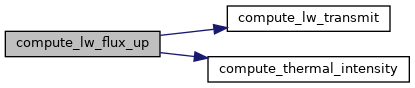
Referenced by vertical_two_stream_sweep().

◆ compute_lw_heating_rate()
| AMREX_GPU_HOST_DEVICE AMREX_FORCE_INLINE amrex::Real compute_lw_heating_rate | ( | amrex::Real | F_net_top, |
| amrex::Real | F_net_bot, | ||
| amrex::Real | dz, | ||
| amrex::Real | rho, | ||
| amrex::Real | cp | ||
| ) |
Compute LW heating rate from net flux divergence.
Given the net LW flux (F_up - F_down, positive upward) at the top and bottom interfaces of a layer, compute the radiative heating rate:
dF_net/dz = [F_net_top - F_net_bot] / dz Q_lw = -dF_net/dz / (rho * cp) [K/s]
Net upward flux increasing with height means the layer loses more energy through its top than it gains through its bottom, i.e. the layer cools (Q_lw < 0). This is the same sign convention as the SW heating rate: energy converging into the layer warms it.
Nonuniform dz Support & Sanity Checks
This function accepts per-level dz values to support terrain-aware or nonuniform vertical grids. When dz <= 0, or rho <= 0, or cp <= 0, returns 0 (heating rate is undefined or unphysical).
The computed heating rate is guarded against NaN/Inf via the same parameter validation.
- Parameters
-
[in] F_net_top Net flux at the top of the layer [W/m^2]. [in] F_net_bot Net flux at the bottom of the layer [W/m^2]. [in] dz Vertical thickness of the layer [m]. Must be positive. For nonuniform grids, use per-level spacing. [in] rho Density [kg/m^3]. Must be positive. [in] cp Specific heat at constant pressure [J/(kg·K)]. Must be positive.
- Returns
- Heating rate [K/s]. Positive values indicate warming. Returns 0 if inputs are unphysical (dz, rho, cp <= 0).
- Note
- The sign convention is: positive dF_net/dz (net upward flux increasing with height) corresponds to cooling (dT/dt < 0).
- For terrain-aware grids, pass dz = z_cc(k+1) - z_cc(k) for each level.
Referenced by vertical_two_stream_sweep().

◆ compute_lw_transmit()
| AMREX_GPU_HOST_DEVICE AMREX_FORCE_INLINE amrex::Real compute_lw_transmit | ( | amrex::Real | tau_lw | ) |
Compute transmission coefficient through an absorbing layer.
For a layer with optical depth tau_lw, the fraction of incident radiation that is transmitted (not absorbed or scattered) is:
transmit = exp(-tau_lw)
The fraction absorbed/scattered is:
absorb = 1 - exp(-tau_lw)
This is used in the two-stream upward/downward sweep formulas.
- Parameters
-
[in] tau_lw Optical depth of the layer [unitless]. Must be ≥ 0.
- Returns
- Transmission fraction [0, 1]. Satisfies transmit + absorb = 1.
- Note
- If tau_lw = 0, returns 1 (fully transparent).
- If tau_lw >> 1, returns ≈ 0 (fully opaque).
Referenced by compute_lw_flux_down(), and compute_lw_flux_up().

◆ compute_thermal_intensity()
| AMREX_GPU_HOST_DEVICE AMREX_FORCE_INLINE amrex::Real compute_thermal_intensity | ( | amrex::Real | T, |
| amrex::Real | sigma | ||
| ) |
Compute thermal (LW) intensity for a given temperature.
Using the Stefan-Boltzmann law, compute the upwelling or downwelling thermal radiation intensity:
I_rad = sigma * T^4
where sigma is the Stefan-Boltzmann constant and T is absolute temperature.
This is a GPU-safe inline function.
- Parameters
-
[in] T Absolute temperature [K]. Must be positive. [in] sigma Stefan-Boltzmann constant [W/(m^2·K^4)].
- Returns
- Radiative intensity [W/m^2]. Always non-negative.
- Note
- If T ≤ 0, returns 0 (unphysical, but defensive).
- For typical terrestrial temperatures (200-400 K), this ranges from ~1 W/m^2 to ~1500 W/m^2.
Referenced by compute_lw_flux_down(), compute_lw_flux_up(), and vertical_two_stream_sweep().

Variable Documentation
◆ stefan_boltzmann
|
constexpr |
Stefan-Boltzmann constant [W/(m^2 K^4)] used by the two-stream LW model.
Referenced by vertical_two_stream_sweep().