TwoStreamRadiation: the two-stream radiation model and its surface state. More...
#include <ERF_TwoStreamRadiation.H>#include <ERF_RadStruct.H>#include <AMReX_VisMF.H>#include <AMReX_PlotFileUtil.H>#include <AMReX_Utility.H>#include <AMReX_Math.H>#include <ERF_RadiationDiagnostics.H>#include <ERF_TwoStreamColumn.H>#include <ERF_TwoStreamCanopyForcing.H>#include <ERF_Constants.H>#include <ERF_PrognosticCloudFraction.H>#include <ERF_AerosolOpticalDepth.H>#include <ERF_SimplifiedSEB.H>#include <ERF_SurfaceMoisture.H>#include <ERF_SEBTurbulentFlux.H>#include <ERF_OrbCosZenith.H>#include <AMReX_Print.H>#include <AMReX_ParallelDescriptor.H>#include <AMReX_Gpu.H>#include <ERF_IndexDefines.H>#include <ERF_EOS.H>#include <algorithm>#include <cmath>#include <ctime>#include <limits>
Functions | |
| TwoStreamSunDate | two_stream_sun_date (const RadChoice &rc, TwoStreamRadiation::OrbitalCache &orbit, double epoch_time) |
| The calendar sun of the two-stream model at a UTC epoch time (start_time + t). More... | |
| void | copy_surface_plane (const MultiFab &src2d, MultiFab &dst) |
Detailed Description
TwoStreamRadiation: the two-stream radiation model and its surface state.
Computes SW/LW fluxes and per-level heating rates using real per-column vertical sweeps over the atmospheric grid. Reads temperature and density from the state and properly accumulates optical depth through all vertical levels.
Capabilities include:
- Height-varying optical depth: optional "cloud_layer" tau_profile_type adds cloud_tau_per_layer on top of the clear-sky background within [cloud_base_height_m, cloud_top_height_m].
- Cloud fraction masking: blends clear-sky and cloudy-column fluxes via F = (1 - cloud_fraction) * F_clear + cloud_fraction) * F_cloudy.
- Diffuse (scattered) SW flux: two-stream reflectance/transmittance per layer combined with the surface albedo by the adding method, giving upward and downward diffuse streams (see ERF_TwoStreamSW.H).
- Per-level heating rate output: writes the SW/LW radiative tendencies of potential temperature, (dT/dt)/pi, to a 2-component MultiFab (component 0 = SW, component 1 = LW), mirroring the RRTMGP convention expected by the RhoTheta source term.
Includes support for:
- Height-varying surface properties (albedo, emissivity, temperature)
- Dynamic cloud fraction from relative humidity and cloud water
- Prescribed bulk aerosol optical depth
- Dynamic solar geometry (time-varying solar position)
- Surface energy balance diagnostics and prognostic updates
Vertical orientation follows ERF: k = kmin is the surface layer and k = kmax the top layer. SW sweeps downward from kmax to kmin; LW sweeps downward (TOA -> surface) and then upward (surface -> TOA). Layer temperature is obtained from rho*theta through the Exner function.
CSV diagnostics (domain means unless noted): SW_surface is the SW absorbed by the surface, SW_TOA the incident SW at the top of the atmosphere, SW_up_TOA the reflected SW leaving the top, LW_net_surface the net (up - down) LW at the surface, LW_up_TOA the outgoing LW at the top, and heating_rate_max the max(|Q_sw|+|Q_lw|) over the column evaluations.
Function Documentation
◆ copy_surface_plane()
| void copy_surface_plane | ( | const MultiFab & | src2d, |
| MultiFab & | dst | ||
| ) |
Referenced by TwoStreamRadiation::write_land_forcing().


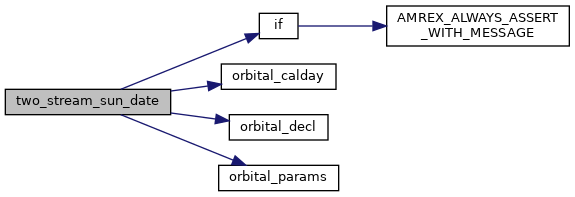
◆ two_stream_sun_date()
| TwoStreamSunDate two_stream_sun_date | ( | const RadChoice & | rc, |
| TwoStreamRadiation::OrbitalCache & | orbit, | ||
| double | epoch_time | ||
| ) |
The calendar sun of the two-stream model at a UTC epoch time (start_time + t).
The calendar sun of the two-stream model at a UTC epoch time: the calendar day with the time of day as its fraction, the declination and the Earth-Sun distance factor, from the date as the RRTMGP interface forms it and the orbital code of ERF_OrbCosZenith.H (orbital_params once per year into orbit, with the erf.rad_orbital_* overrides passed to it, then orbital_decl per call). set_solar_state() takes the sun of every sweep from here, and the immersed-boundary balance its erf.ibseb.sun_mode = two_stream sun, so the two cannot drift apart.
Referenced by ERF::ibseb_set_two_stream_sun().